

Star Power
... in which Bob goes electric.

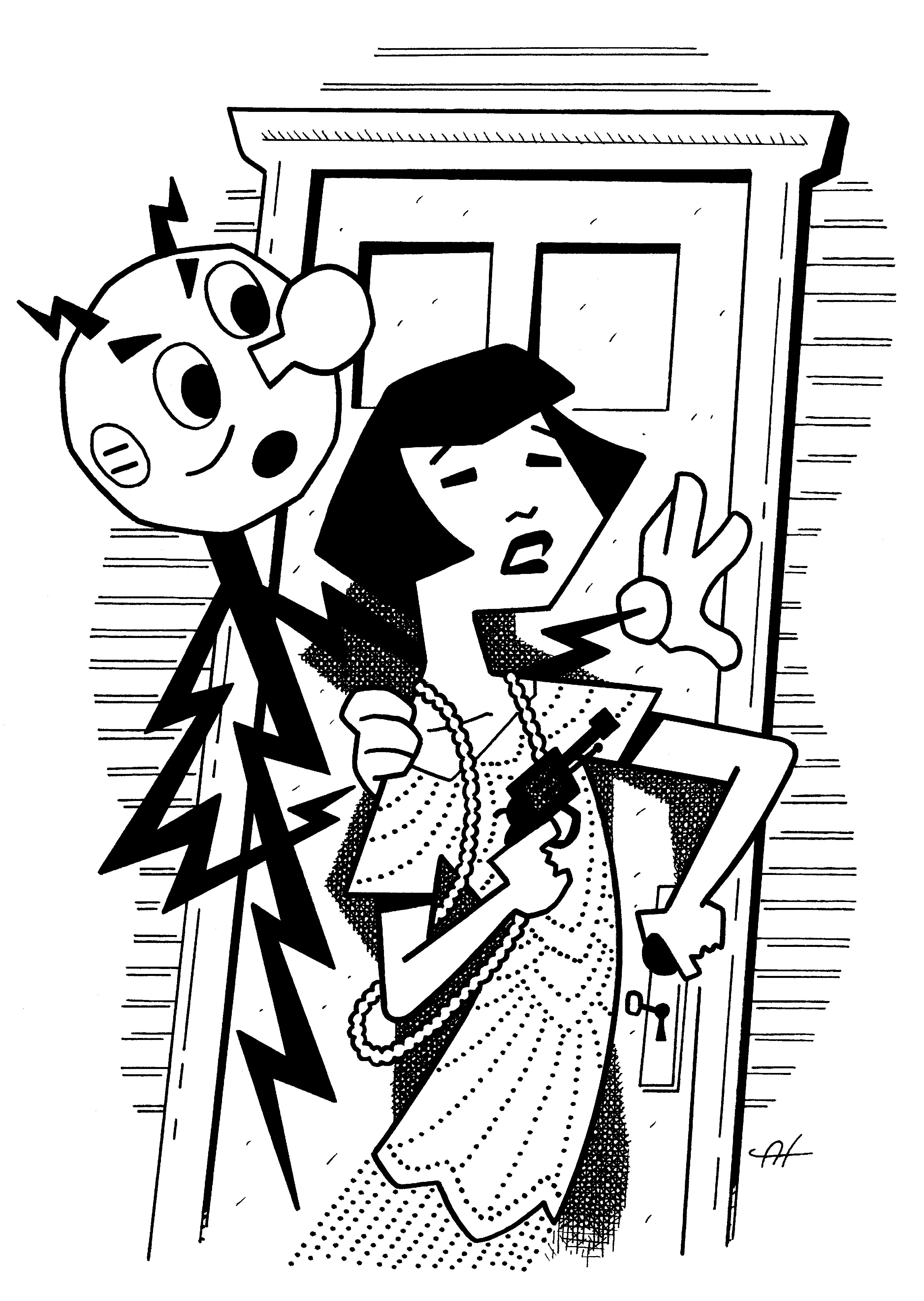
According to family legend, Aunt Bob was married to Reddy Kilowatt. And as you can imagine, her parents, eager to see the youngest Threadgill girl leave the farm, might have approved of this arrangement had Aunt Bob’s husband been non-fictional. As it was, Julia “Bob” Threadgill Kilowatt had chosen to wed the animated cartoon spokesman for a major electric utility conglomerate. This was clearly delusional. Bob was a simple country girl, and Reddy was way out of her league.
Like many faded celebrities, Reddy Kilowatt is remembered by few today. His star burned brightest in our grandparents’ day, when the character appeared in advertisements, safety pamphlets, comic books, and theatrical cartoons, produced to promote the endless benefits of household electricity. This company mascot was intended especially to soothe the nerves of newly-wired Southerners, who suspected this newfangled electricity was a dangerous plot by the Northern elite to convert the hayseeds to Satanic communism and the like. This included the Threadgill farm, where corncobs were routinely crammed into empty light sockets to prevent the electricity from roaming the air and poisoning the hearts of children like little Julia.
Julia was called “Bob” because of her bobbed hairstyle, the kinky, Louise Brooks cut popular among free-spirited young women of the 1920s. I like to picture Aunt Bob in her flapper stylings, a vibrant rebel desperate to shake the red dust off her Mary Janes and Foxtrot with Scott and Zelda on the wings of Lindbergh’s custom Ryan and other Ken Burns fantasia. Such a wild child would naturally dismiss the local cowpoke suitors and make an avant-garde choice like Reddy for her beau. A man of power and influence, kind yet energetic, cautious yet dangerous. A product of Madison Avenue, of whom her father would not approve.
As is often the case concerning women, I am reading quite a lot into a haircut. All we lowly Threadgill descendants know for sure about Aunt Bob is that one day, attendants from the state mental health facility in Columbia, SC, came to take her away from her kinfolk. Unhappy with this proposition, Bob locked herself in her room with a pistol. And when her father attempted to coax her out, she shot through the door and wounded him, securing for herself a future of Thorazine and solitaire.
As a youngster, I was impressed with this story because a) I was also hopelessly in love with a number of cartoon characters, and b) I cherished the romantic daydream of shooting my father when he attempted to enter my room.
But also because Aunt Bob was a certifiable, officially diagnosed lunatic in my family tree. Not just a Schlitz-brained cousin or bipolar uncle or senile grandma who thought Bing Crosby was still president; Aunt Bob was a genuine, loony-bin lifer, with papers and everything. A colorful crackpot, uniquely delusional, from my own paltry bloodline. And so I took perverse pride in this family lore, believing that, by extension, my own pedestrian mental problems had a certifiable pedigree. Some have nobles in their ancestry, some have heroes of historic battles. We had Aunt Bob, Mrs. Reddy Kilowatt herself.
This was in keeping with my preferred view, based on no research whatsoever, that mental illness is a wholly singular experience. That is to say, I believed a sane individual could just be minding his or her own business, thinking everyday thoughts about postage stamps and Sanka, when their brain suddenly malfunctions, like a burst appendix. A host of hallucinatory misunderstandings might then enter one’s thought patterns – talking toasters or levitating housepets – but these misfirings of the frontal lobe are, I assumed, manifestations of that person’s unique personality. Psychosis as a product of one’s personal brand.
Aunt Bob didn’t catch “Reddy Kilowatt” off a toilet seat; the infatuation was her own invention. Her individually-tailored1 interests, stepping out in Crazytown. Reddy was Aunt Bob’s own thing, and soon enough, he was her everything. She had, through the glorified process of psychotic breakdown, spun idiosyncratic straw into schizophrenic gold.
Over the years, in my capacity as a public service employee, I’ve gained a lifetime of experience humoring lunatics. Perhaps they can sense the unhinged kinship in my Threadgill genetics, but for whatever reason, when someone hears voices in his Doritos or communes with the mystic aura of Ramses in his cactus flowers, I’m the guy he wants to talk to about it. And while getting to know these beautiful kooks has revealed some seminal dementia, I have not failed to notice some rather predictable preoccupations among the cracked. Radios transmitting messages, secret cabals controlling the weather, Gods assigning messianic missions, enemies stealing thoughts, demons poisoning the air ducts, and germs, germs, germs. Some of the common symptoms of psychosis begin to seem very common indeed.
And yes, that includes celebrity fixation. Whether it’s Tom Brokaw’s coded instructions, a promise of marriage from Taylor Swift, or a firm belief that Michael Jordan’s free throws caused one’s liver cancer, the kooks quite often exhibit a pronounced preoccupation with a famous person. And here, I must include Tammy Wooten, a regular patron at the Spartanburg County Public Library, who was fully obsessed with Tweety Bird, that classic animated character from the world of Saturday morning cartoons. Tammy was consistently dressed in Tweety-branded attire and never let the topic of conversation drift away from her beloved cartoon bird.
Yes, one may argue that Tammy’s collecting and displaying of Tweety Bird-branded shirts, shoes, ballcaps, belt buckles, fanny packs, keychains, eyewear, and jammie pants may be behaviors indicative of conventional fandom.2 Hundreds of thousands of people, you’ll say, have purchased the same merch, perhaps amassing even larger collections. But I’d suggest that building such Tweety shrines betrays a fanatical slope that’s slippery as all get out. Particularly when the collector contends, as Tammy often did, that she converses with Tweety Bird. Shares secrets with Tweety Bird. Solicits advice from Tweety Bird. Believes in Tweety Bird.
I agree, personal obsession is different from mass adulation. But that difference can be terrifying. When your Aunt Bob tells you she has a personal relationship with Reddy Kilowatt, you take steps to have her committed for psychiatric care. But when twelve people, dressed in matching footwear, accost you with The RK Way (“The boss wants to talk to you about the healing light of Reddy Kilowatt”), it is you who must change your address.
Now imagine that Reddy Kilowatt is not a benign spokesman for household safety, but a vindictive corporate strongman, seizing power through the threat of electrocution, selling Reddy Kilowatt hats, flags, and trading cards as signifiers of loyalty, and punishing those who do not heed his warnings with kidnapping, firing, and/or death and imprisonment. Imagine that Reddy rose to prominence because massive throngs of Reddyhatters had seen him on TV, found his iconic image irresistible, convinced themselves of his personal devotion, and pledged themselves to Reddy to piss off members of their families.
You might see how such a state of affairs would change my perception of mental illness. Until now, I’d been cherishing the crackpots as special somebodies, who were dear to me exactly because their slipped gears made them unable to function like the rest of the multiturds. They’re too hung up on their interior voices and invisible friends to march in lockstep with the masses – the masses, that swarm of interchangeable dipshits, crowding arenas in their color-coded outfits, chanting for more Bon Jovi, more Kardashians, more 49ers, more Tweety Bird. My crazies weren’t like those crazies. My crazies were one-of-a-kind crazy. Crazy like me.
But it turns out you can just dump Reddymania into the water supply. And that it’s not just the cult of personality that can infect the population, but paranoia, delusions of grandeur, messianic missions, invisible enemies, global conspiracies, and so many other DSM favorites. The crazy is contagious, and America won’t get vaccinated. All because the cartoon characters on TV sang their jingles and projected electric power. In the name of safety.
Solipsistic as it seems, this is the aspect of America’s latest goosestep into autocracy I find the most hurtful. The mainstreaming of crazy took the shine off of Aunt Bob.3 She and all the other barking loons I have loved, exceptional in their raving fantasies and hallucinations, have been overshadowed by a crackpot conglomerate, their madness homogenized, their infatuations coopted. The tourists found out about Crazytown, and Julia Threadgill’s idolization of a fluorescent celebrity is no longer just the stuff of flappers and freaks. Now, everyone’s in the Kilowatt Klub, and they’re prepared to destroy anyone who refuses to join the Reddy Revolution.
As so often happens these days, the modern apocalypse inspires me to memories of sunnier apocalypses past. I think back to the not-quite-as-bad old days. Back to 1999, for example, at the end of that quaint, old century, when a deranged psychotic man broke into the home of superstar musician George Harrison and stabbed him repeatedly. This was hardly the first violent incident involving a member of the Beatles, as inflicted by someone with an unbalanced obsession with that legendary rock band. It occurred to me that, in centuries past, such maniacs had typically been driven to violence by religious delusions, thinking themselves Old Testament prophets or agents of God’s retribution. Today’s psychotics, it seemed, tend to formulate their delusions around media celebrities.
Which meant that John Lennon was right. The Beatles are more popular than Jesus Christ.
- A.H.
Some might describe these as “bespoke interests,” but I have vowed to loosen the teeth of anyone using this horrible and inexplicably trendy word.
The madness of fandom is a topic for another day. Suffice it to say for now that I cannot accept that anyone actually likes the cringe-inducing Tweety Bird character and that the merch acquisition is its own obsessive-compulsive twitch, irrespective of subject, like a loveless nymphomania.
The KKK took my baby away.


(And let’s not forget Ashley’s website, jam-packed with portraits and other drawings, his highly affordable prints and books currently available, his eagerness for your portrait commission, and his contact email, thrdgll@gmail.com, where he longs to hear from you.)
I miss you on facebloke but glad you're continuing to bob up amidst the debris to buoy my spirits.
Excellent read, just aces. Speaking of Reddy, I remembered this fine little vignette featuring a John Goodman in a parody of some show he used to star in. https://www.youtube.com/watch?v=HZdshRVmIuc